Hormone Doctor Reveals: The Real Reason Menopausal Belly Fat Won’t Go Away – And What Helps Women After 40 Lose Weight Again
 6
6
 3459654
 12 min
If you’re over 40 and your body feels like it changed overnight, this article will explain why.

I’m Dr. Rachel Vance, a women’s hormone and metabolism specialist in Chicago.
For the past 17 years, I’ve worked with women going through perimenopause, menopause, and the difficult years that follow.
And I want to say something clearly before we go any further.
If your body changed after 40, if your belly suddenly looks bigger, if your old diet stopped working…
If you feel tired, puffy, hungry, and frustrated…
You are not failing, you are not weak, and you are not “letting yourself go.”
You have simply been trying to solve the wrong problem.
I used to think estrogen was the main problem, too
For years, I believed what most doctors are taught to believe.
That menopausal weight gain is an estrogen problem.¹
And honestly, it makes sense on paper.
Estrogen drops = metabolism slows = the body starts storing fat differently = the waist gets thicker.
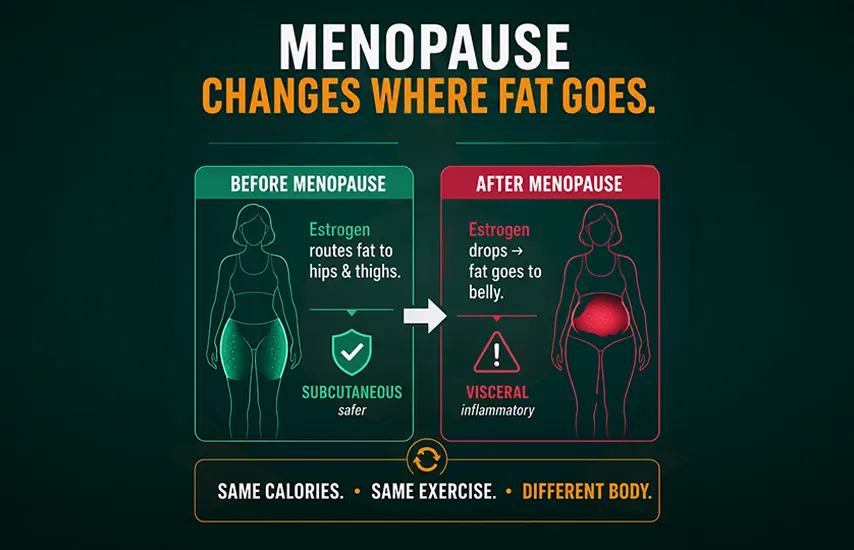
So when women in their 40s came to me saying, “I’m eating the same, but I keep gaining weight,” estrogen was always the first explanation.
But a couple of years ago, I started seriously questioning that.
Because if estrogen was the whole problem, then estrogen-focused solutions would help women lose weight
And that’s not what I was seeing at all.
So I started digging deeper.
And what I found changed the way I look at menopausal weight gain completely.
Turns out, cortisol is what actually makes you gain the weight and makes it impossible to lose the weight once it’s already there.²
So the real issue was not that these women were lazy.
They were trying to solve an estrogen problem when it was always a cortisol problem to begin with.
Let me explain.
The weight gain that makes no sense
Cortisol is known as the stress hormone, but I do not like that name.
It makes cortisol sound emotional, as if it only rises when you are overworked or upset.
That is NOT true!
Cortisol also rises when your body is under physical stress.
- Poor sleep is stress
- Blood sugar swings are stress
- Hormonal changes are stress
- Undereating or following diets is stress
- Pushing through exhausting workouts is stress
And during menopause, many women are living inside all of those stress signals at once – so the body reacts the only way it knows how.
It protects you, it slows down fat burning, raises cravings for fast energy, makes sleep lighter, and stores more fat around the belly.
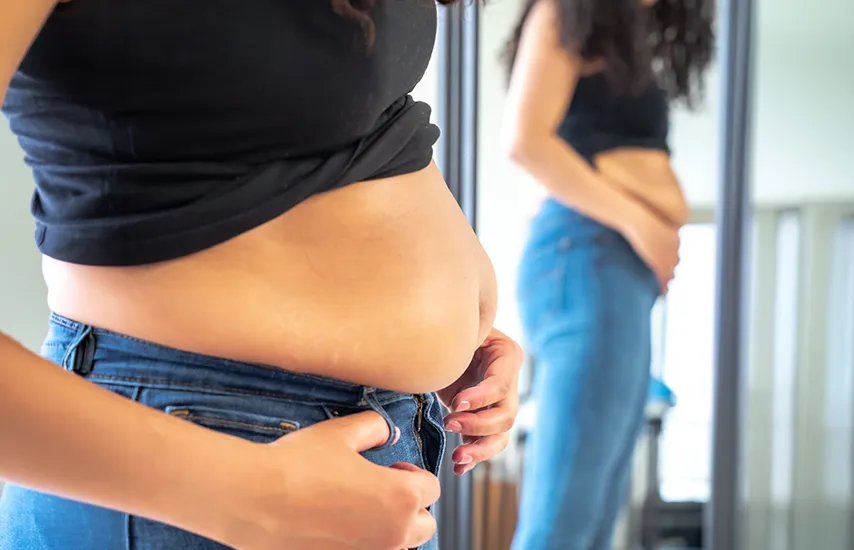
That’s exactly why the Seattle Midlife Women’s Health Study caught my attention.
Researchers followed women through the menopausal transition and early postmenopause, and cortisol was one of the key hormones they tracked as this shift was happening.³
It confirmed what I was already seeing in women every day – cortisol was not some random stress issue; it was an essential part of why all this weight gain during 40s and 50s feels so CONFUSING.
Because from the outside, it looks like nothing changed.
You eat the same, move the same, live the same life – but inside, your body is reacting to menopause like a constant stress signal.
So instead of burning fat the way it used to, it starts holding on to it.
Especially around the belly.
Cortisol tells your body, “Hold on, something is wrong! Save energy, store more fuel.”
That’s helpful if you’re in danger.
But it is absolutely not helpful when you’re trying to lose weight.⁴
In fact, one Yale study found this same belly-fat pattern years ago: women with more abdominal fat had higher cortisol responses to stress.⁵
And researchers also noted that cortisol pushes fat storage toward the center of the body, around the organs.
This is why “eat less, move more” does nothing but creates even more stress.
Sleep gets worse, the cravings hit at night, energy drops, and the scale barely moves.
The belly seems to get even bigger.
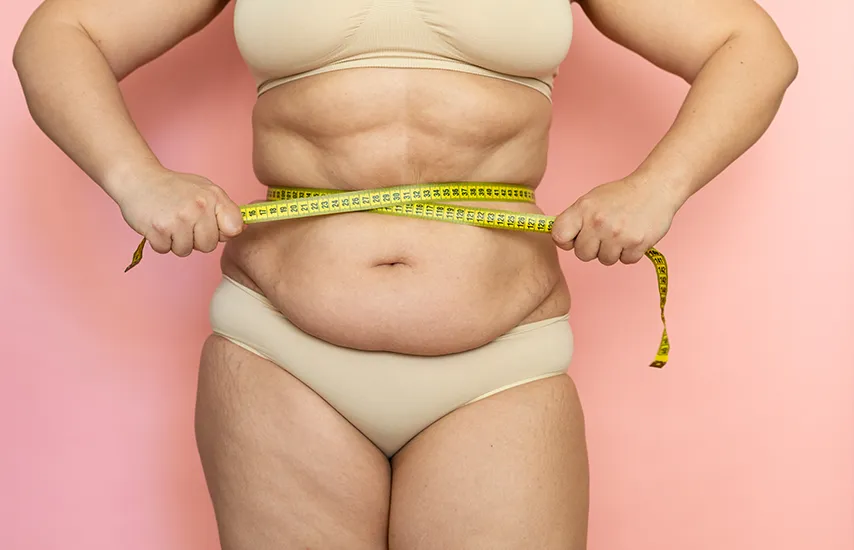
That is because dieting harder elevates the same stress signal you’re trying to escape.⁶
Your brain does not see a new diet as “healthy”
It sees it as a shortage, and shortage means more stress, and stress means cortisol, and cortisol means belly fat.⁷
So the women think they need more discipline.
But what they really need is a completely different solution to this problem.
They don’t need to punish the body harder.
They need to calm the cortisol signal that’s making the body hold on to fat so desperately.
Exercise falls into the same trap
Don’t get me wrong, I am definitely not against exercise.
Movement is extremely important, walking is excellent, and strength training helps protect muscles and bones.
But menopause is not the time to treat your body like your #1 enemy.
Many women panic when they start gaining weight and push even harder:
❌ MORE cardio,
❌ MORE intense pilates classes,
❌ LONGER workouts,
❌ FEWER rest days.
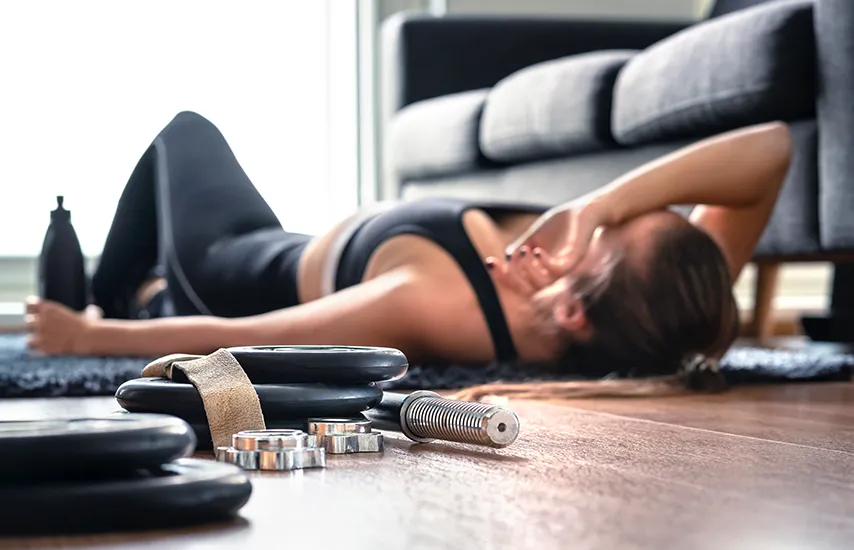
But if you’re already waking up tired and fighting cravings every waking hour of your life, your body is not seeing those workouts as “weight loss.”
It’s seeing them as MORE STRESS.
And more stress = more cortisol.
That’s why women work out harder and still see the weight creep up.⁸
Not because exercise is bad, but because the body is stuck in the wrong hormonal response.
You cannot outwork or outdiet high cortisol
Now, let me be clear – estrogen matters, too.
When estrogen falls, it affects sleep, mood, body temperature, libido, bones, etc.⁹
But to be fair, lower estrogen is simply part of being a woman.
It naturally declines with age, and unless you choose serious hormonal intervention, you cannot force your body to stay in the same hormonal state like you’re 25 forever.
Nor should you feel like you have to – aging is a natural part of being human.
But cortisol is different.
High cortisol is not something that only happens because you’re getting older.

It can rise at any age when the body is under enough stress.
Menopause simply creates the perfect conditions for it to stay high.¹⁰
And once cortisol rises, the body starts acting like it is under a constant threat.
That is when belly fat becomes stubborn, cravings feel stronger than your willpower, and the same routine that worked at 35 stops working at 45 or 55.
This is why so many women feel TRAPPED.
The answer is in your gut?
Most women are surprised when I tell them this, but the gut is one of the most important places to look when your cortisol is high.
Your gut is not just a “digestion tube.”
It’s a control center that speaks directly to your brain through something called the gut-brain axis.¹¹
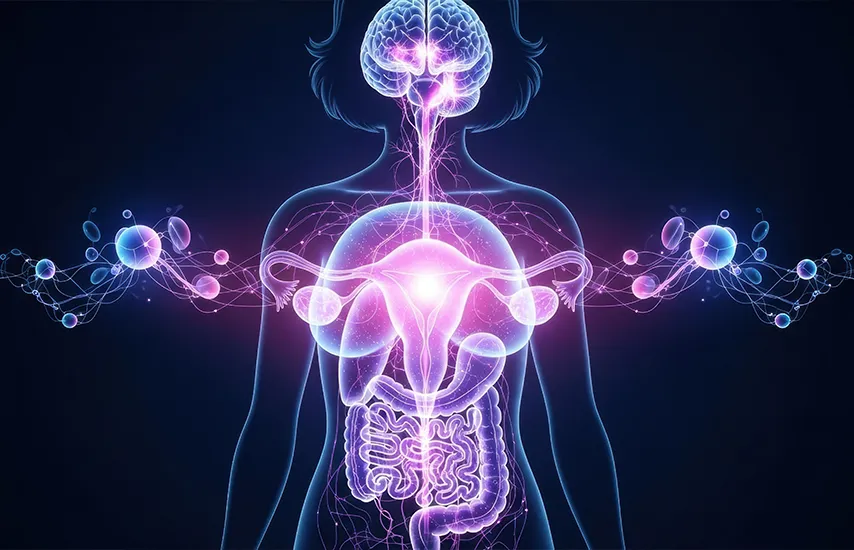
And it does something most women have never been told about.
Your gut helps your body process cortisol.¹²
Certain gut bacteria help metabolize cortisol and related stress hormones, which means your gut microbiome plays a major role in how well your body handles stress.¹³
So when your gut is balanced, your body has no problem with processing cortisol properly.
But that balance is fragile.
Poor sleep, stress, dieting, blood sugar swings, low-fiber meals, and overexercising can all push it out of balance – especially when the body is already going through menopause.¹⁴
And when your gut microbiome is out of balance, your body’s cortisol-handling system doesn’t work anymore.
That is why “just eat less” is such shallow advice.
It does not fix your gut microbiome, it does not support the body’s cortisol-handling system.
And it does not help the body feel safe enough to release the weight it keeps storing.
The real goal is not to starve the body into submission.
The real goal is to help the body stop acting like it is under attack.¹⁵
And that starts in the gut, by making cortisol processing efficient again.
This is why I started looking for a real gut-based solution
For years, I watched women try the same things over and over.
Protein, low-carb diets, fasting, walking challenges, massages, hormone teas, expensive powders, generic probiotics.
Some things helped a tiny bit, but 95% did not touch the weight gain at all.
That was the part that bothered me most.
Because these women were not doing nothing – they were doing more than ever.
But most of the solutions they tried were only touching one small part of the problem.
A diet might reduce calories, but it would also elevate cortisol.
A workout plan might burn energy, but it would add more stress to an already stressed body.
That is when I stopped looking for another “menopause supplement” and started looking for something REALLY specific.

I wanted a formula that made sense in real life, for real women – not just in theory
That’s when I made this “must-have” list:
- It had to support the gut bacteria involved in cortisol processing.
- It had to feed those bacteria, so they could survive and grow.
- It CANNOT be just random probiotics.
- And just as importantly, it had to be designed to actually reach the gut.
Because if the formula does not survive the journey through stomach acid, it does not matter how impressive the label looks.
My “must-haves” weren’t random as well.
You see, scientists at Oxford found that volunteers taking prebiotics lowered their cortisol by 30% in 3 weeks – compared to volunteers who simply took a placebo.¹⁶
More than that, one study published in the Journal of Functional Foods showed that combining prebiotics with probiotics can lower your cortisol up to 39% within 8 weeks!¹⁷
So, after a few weeks of analyzing research papers, comparing labels, reading ingredient breakdowns, and ruling out formulas that looked good only on the surface, I finally came across Bioma.
It was not just one random probiotic strain.
It was a full gut-support system: probiotics, prebiotics, postbiotics, and delayed-release capsules.
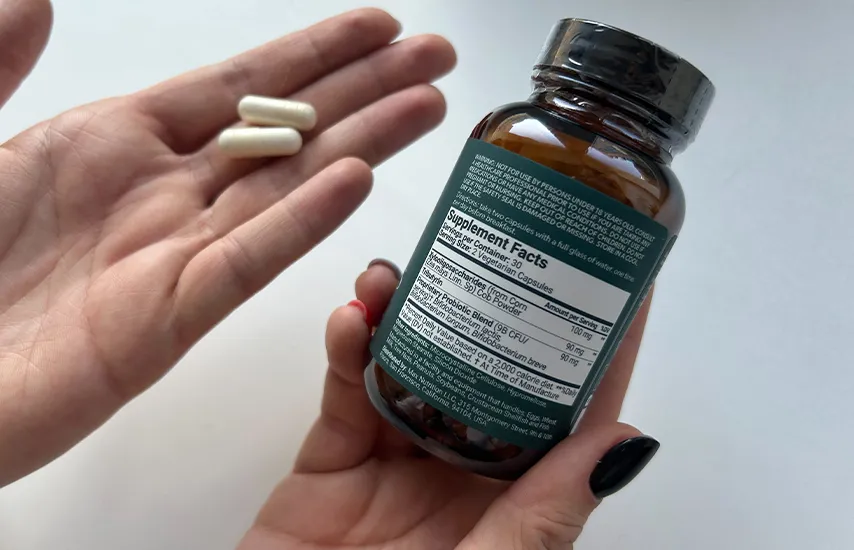
And for the first time, I saw a formula that not only matched the science, but matched the problem I was actually seeing in real women every single day, too.
Why Bioma is different from anything I’ve recommended before
Bioma is not just another “probiotic for bloating.”
That’s what made it stand out to me.
Most probiotics are built around one simple idea: add good bacteria and hope digestion improves.
But for women dealing with menopausal weight gain, that’s absolutely not enough.
Because the real issue is not bloating – it’s the gut-cortisol loop.
And since the gut plays a major role in how the body handles cortisol, the formula has to support that process from all angles.
That’s why Bioma simply makes sense.
First, it contains three Bifidobacterium strains – Bifidobacterium lactis, Bifidobacterium longum, and Bifidobacterium breve.
This is the type of beneficial bacteria I was specifically looking for because of its role in gut balance and cortisol + estrogen processing.¹⁸
Then it includes XOS, a prebiotic that feeds those good Bifidobacteria.¹⁹ Check!
(The prebiotic part matters because adding probiotics without feeding them is like planting seeds in dry soil. You might put them there, but that doesn’t mean they’ll grow.)
Bioma also includes Tributyrin, a postbiotic that helps support the gut environment itself.²⁰ As a cherry on top, it helps speed up your metabolism to burn more fat!²¹
So instead of just adding random probiotics and hoping for the best, Bioma supports the whole gut setup:
the bacteria,
the fuel,
and the environment around them.
And then there is the delivery.
Bioma uses delayed-release capsules, which matters because the formula has to actually reach the gut.²²
That’s why I swear by this approach now.
Two capsules instead of another impossible routine
Most women do not need more instructions.
They already know how to eat protein, they already know walking is good, they already know sleep matters.
The problem is not knowledge – it is that menopause makes the basics harder.
How do you “sleep better” when cortisol wakes you at 3 a.m.?
How do you “eat less” when cravings hit every night?
How do you “work out more” when you already woke up tired?
That is why Bioma fits your real life.
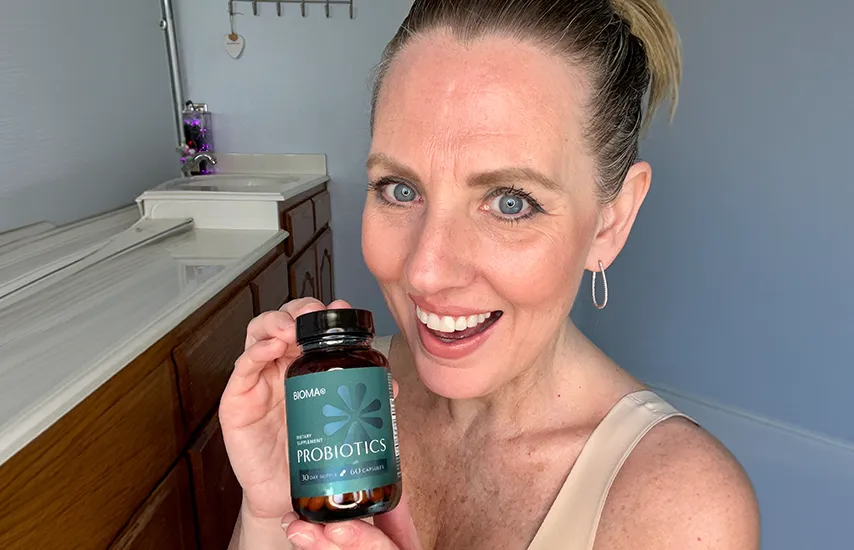
You take two capsules in the morning.
That’s it.
No complicated schedule, no injections, no extreme diet, no expensive organic food routine.
And that’s why with Bioma, women who had been stuck for years are finally losing weight again.
They come in to see me, and all tell me the same story: their cravings are so much easier to handle, their bloating has improved, and the scale is finally moving in the right direction!

Most importantly, they’re not doing anything extreme.
They’re just taking two capsules every morning and giving their gut the support it’s been missing.
Who should try Bioma?
Bioma is for women who feel like their body changed after 40 and their old routine no longer works.
Especially if the main problem is belly fat, bloating, cravings.
Because at that point, another strict diet is 100% not the answer.
Neither is forcing yourself through harder workouts when you already feel drained.
If cortisol is keeping your body in stress mode, you need to support the gut-cortisol connection directly.
That is where Bioma makes sense.
It is simple, easy to take, and designed for women who want support that fits into their real life – not another impossible routine.
Why waiting more just keeps the same cycle going
Because this problem won’t disappear on its own.
Most women tell themselves they will start again Monday.
Or next month.
Or after the holidays.
But then more time passes, and they are still dealing with the same belly fat, the same cravings, the same bloating, and the same frustration.
If you have already tried eating less, walking more, cutting snacks, and being “more disciplined,” then doing the same thing harder is not going to change a thing.
At some point, it makes sense to try a different approach – and that is Bioma.

Try Bioma while today’s offer is available
Right now, Bioma is available with a limited-time online offer.
You can check availability today and see if you qualify for the current discount.
Every order also comes with free shipping and a money-back guarantee, so you can try it at home without the usual risk.
If you’re tired of fighting the same belly fat, trying stricter diets, and wondering why your body no longer responds the way it used to, Bioma gives you a simpler place to start.
Try Bioma today while the current offer is still available.
IMPORTANT UPDATE
Since this article was published on Health Insider, Bioma has gained tremendous attention and interest. The company has reached out to our editorial team to inform us that, for a limited time, they are offering our readers an exclusive 35% discount on Bioma. Plus, every order comes with free shipping and a money-back guarantee.

 22 sources
-
Weight gain during the menopause transition: Evidence for a mechanism dependent on protein leverage
https://pmc.ncbi.nlm.nih.gov/articles/PMC10952331/ -
Cortisol levels during the menopausal transition and early postmenopause observations from the Seattle Midlife Women’s Health Study
https://journals.lww.com/menopausejournal/abstract/2009/16040/cortisol_levels_during_the_menopausal_transition.19.aspx -
The Seattle Midlife Women’s Health Study: a longitudinal prospective study of women during the menopausal transition and early postmenopause
https://pubmed.ncbi.nlm.nih.gov/30766702/ -
The Role of Cortisol in Chronic Stress, Neurodegenerative Diseases, and Psychological Disorders
https://pmc.ncbi.nlm.nih.gov/articles/PMC10706127/ -
Stress May Cause Excess Abdominal Fat In Otherwise Slender Women, Study Conducted At Yale Shows
https://www.sciencedaily.com/releases/2000/11/001120072314.htm -
Low calorie dieting increases cortisol
https://pubmed.ncbi.nlm.nih.gov/20368473/ -
Stress-induced cortisol response and fat distribution in women
https://pubmed.ncbi.nlm.nih.gov/16353426/ -
The Effects of Weight Loss and Aerobic Exercise on Cortisol and Cortisol Suppression in Postmenopausal Women with Overweight and Obesity
https://pmc.ncbi.nlm.nih.gov/articles/PMC12045736/ -
Understanding Estrogen Action during Menopause
https://pmc.ncbi.nlm.nih.gov/articles/PMC2717878/ -
Increased urinary cortisol levels during the menopausal transition
https://pubmed.ncbi.nlm.nih.gov/16645535/ -
The gut-brain axis: interactions between enteric microbiota, central and enteric nervous systems
https://pmc.ncbi.nlm.nih.gov/articles/PMC4367209/ -
Gut Bacteria Improve Depressive Symptoms by Degrading Cortisol into Androgen
https://pmc.ncbi.nlm.nih.gov/articles/PMC12931197/ -
Stress & the gut-brain axis: Regulation by the microbiome
https://pmc.ncbi.nlm.nih.gov/articles/PMC5736941/ -
The Gut Microbiota and Inflammation: An Overview
https://pmc.ncbi.nlm.nih.gov/articles/PMC7589951/ -
Cortisol level dysregulation and its prevalence—Is it nature’s alarm clock?
https://pmc.ncbi.nlm.nih.gov/articles/PMC7749606/ -
Prebiotic intake reduces the waking cortisol response and alters emotional bias in healthy volunteers
https://pmc.ncbi.nlm.nih.gov/articles/PMC4410136/ -
Effect of prebiotic and probiotic supplementation on circulating pro-inflammatory cytokines and urinary cortisol levels in patients with major depressive disorder: A double-blind, placebo-controlled randomized clinical trial
https://www.sciencedirect.com/science/article/abs/pii/S1756464618306170 -
Bifidobacteria and Their Role as Members of the Human Gut Microbiota
https://pmc.ncbi.nlm.nih.gov/articles/PMC4908950/ -
Xylooligosaccharides Increase Bifidobacteria and Lachnospiraceae in Mice on a High-Fat Diet, with a Concomitant Increase in Short-Chain Fatty Acids, Especially Butyric Acid
https://pmc.ncbi.nlm.nih.gov/articles/PMC8041301/ -
Tributyrin alleviates gut microbiota dysbiosis to repair intestinal damage in antibiotic-treated mice
https://pubmed.ncbi.nlm.nih.gov/37523400/ -
Tributyrin Attenuates Metabolic and Inflammatory Changes Associated with Obesity through a GPR109A-Dependent Mechanism
https://pmc.ncbi.nlm.nih.gov/articles/PMC7563536/ -
Survival of Probiotic Bacterial Cells in the Upper Gastrointestinal Tract and the Effect of the Surviving Population on the Colonic Microbial Community Activity and Composition
https://www.mdpi.com/2072-6643/16/16/2791


Comments (6)
Leave a comment

Thank you for your comment

I’ve spent 5 years hating my body, blaming myself, trying harder, failing, feeling worthless. Reading that the problem was cortisol and my gut – not my willpower – feels like someone finally lifted a weight off my shoulders. Ordering now and actually feeling hope!
For the post-menopausal question – I’m 61 and 5 years past menopause. 11 weeks on Bioma, down 22 lbs. It absolutely works for us too!
To whoever asked about bloating – mine was GONE by week 2. I used to look pregnant every evening. Now my stomach is flat all day. Down 19 lbs in 10 weeks but the bloating relief came first and fastest
8 weeks on Bioma and I finally understand what Dr. Vance means about the body “feeling safe enough to release weight.” Down 16 lbs and I’m not starving myself. I’m actually eating MORE than when I was dieting and still losing. My body stopped fighting me!
The 35% discount plus money-back guarantee makes this risk-free. Either it works or I get my money back. Just ordered after reading through all the comments
The “two capsules instead of another impossible routine” sold me. I’m exhausted. I can’t do another complicated protocol. Just ordered with the discount 🤞